Termination Clauses and Founder Equity: An Empirical Look at Indian VC Market Practice
Blog
Jul 28, 2026
?
min to read

Termination provisions governing founder equity are among the most negotiated terms in Indian venture capital transactions. To ground these negotiations in data, we analysed over 100 Indian private limited companies that raised institutional venture capital in 2025, examining how deals allocate rights over founder shares upon various termination scenarios.
This article presents our key findings and is a reproduction of our newsletter. A full report is available on request at admin@boolean.legal.
The definition of "Cause" is the single most critical threshold in these provisions, given the prevalence of full forfeiture:
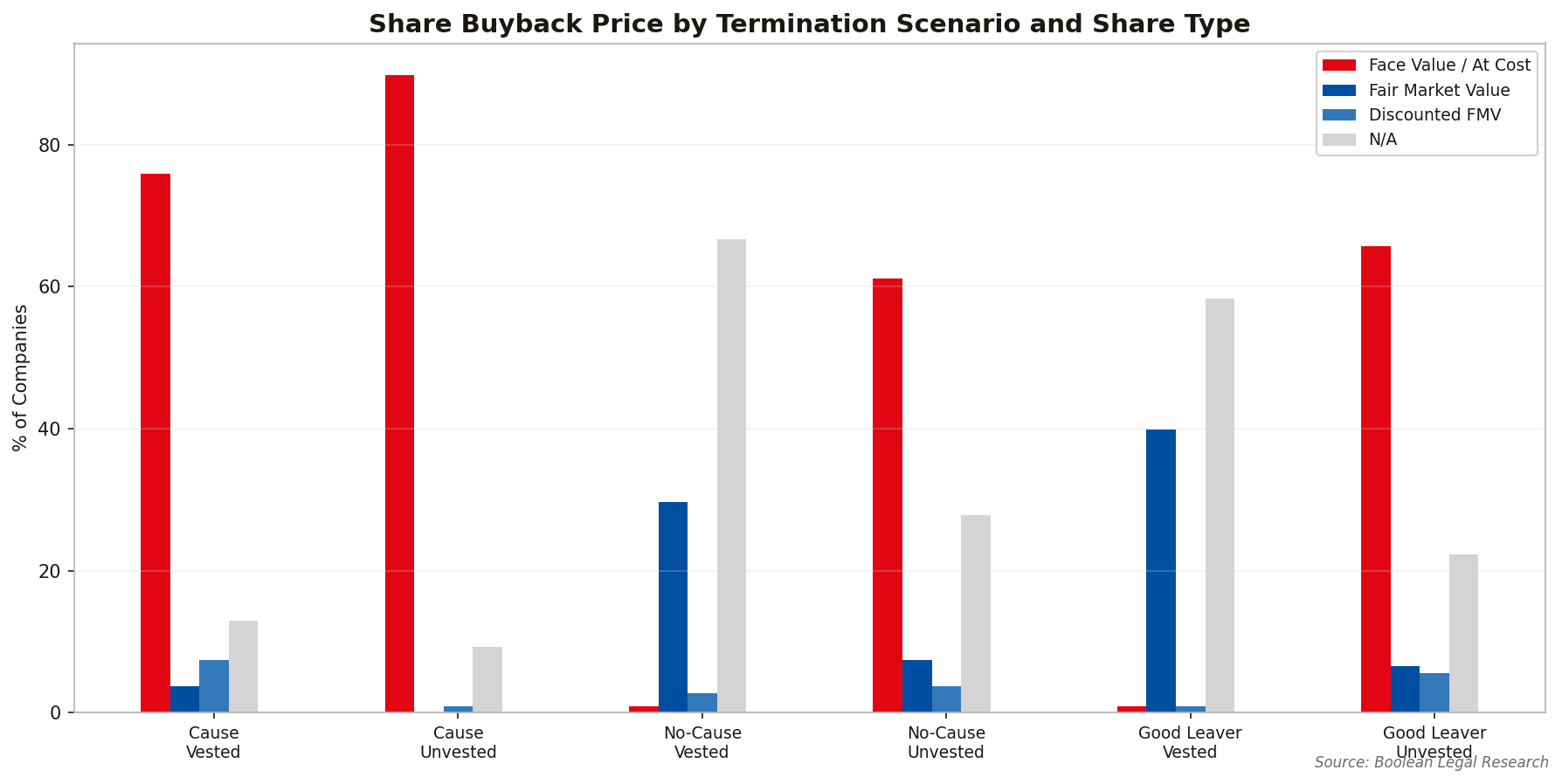
Once the Cause threshold is crossed, the economic treatment of the departing founder's shares becomes the operative question. Our data reveals significant variation depending on the termination scenario.
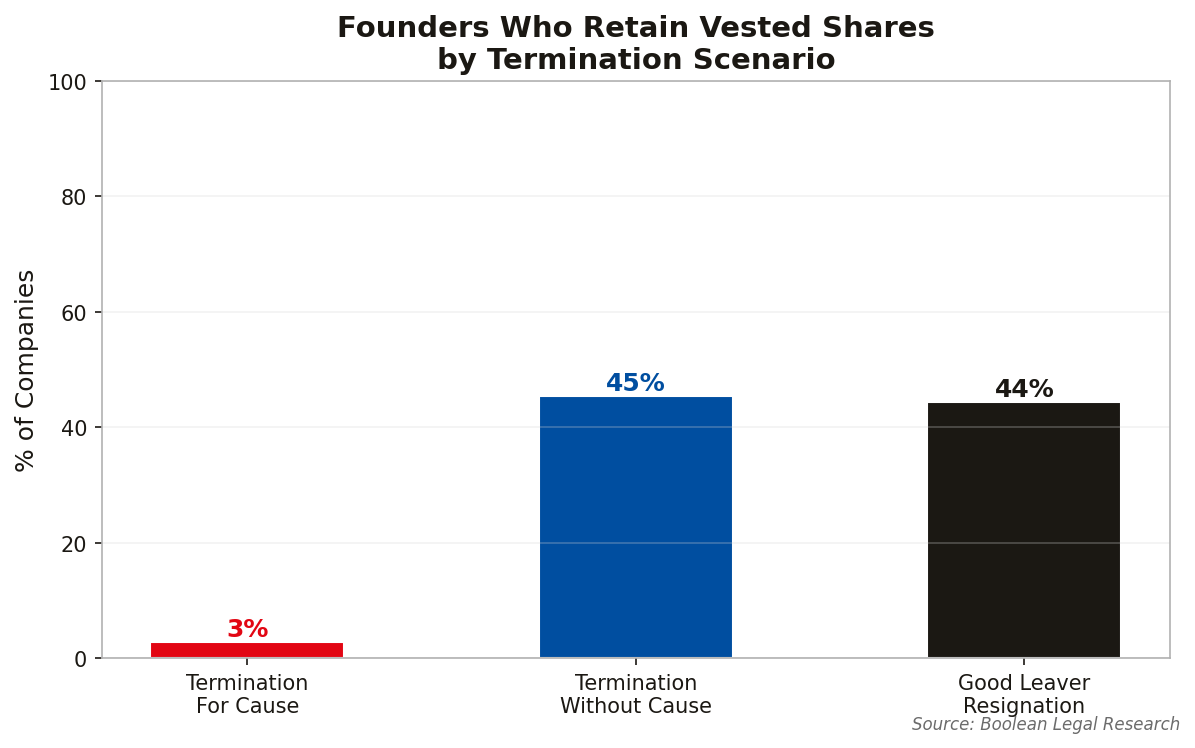
The most significant economic consequence of the Cause/No-Cause distinction is visible in the retention data.
A notable pattern emerges when the data is segmented by vesting status: the treatment of unvested shares is relatively consistent across termination scenarios, while the treatment of vested shares diverges sharply depending on the nature of the exit.
The data reveals several areas where current market practice may warrant closer attention from both investors and founders. We frame these not as critiques of existing practice, but as areas where deliberate, informed negotiation is likely to produce more durable and balanced outcomes than reliance on precedent templates.
A. Materiality and Breach Scope
15.7% of deals still treat "any breach" of the shareholders' agreement as a sufficient trigger for Cause. An overly broad Cause definition invites challenges to justify the "Nuclear Option"; on the other hand, an overly narrow one may leave genuine misconduct unaddressed. Both sides benefit from clarity.
B. Cause Determination Process
Only 35.2% of companies route determination of certain categories of Cause to a neutral adjudicator; an independent determination mechanism serves both sides. The 19.4% of deals that are silent on the determination mechanism create ambiguity that neither party is well-served by, and which costs little to resolve at the drafting stage.
C. Retain Rights on Vested Shares
The significant disparity between Cause (2.8% retention) and No-Cause (45.4% retention) outcomes for vested shares reflects the market's view of Cause termination as carrying meaningful economic consequences. Parties may wish to consider whether the current binary (i.e. near-total forfeiture on Cause vs. significant retention on No-Cause) adequately addresses the full spectrum of termination circumstances, or whether more graduated approaches may better serve both sides' interests in specific deal contexts. Where a call option for vested shares is present for No-Cause exits, parties should consider benchmarking it to FMV pricing (including a discount on FMV), which is evidently the market norm for non-fault exits.
Interested in reading the full breakdown? Email us at admin@boolean.legal to get access to our full report.
We analyse over 100 Indian private limited companies that raised institutional venture capital last year to understand how deals allocate rights over founder shares upon various termination scenarios.
Navigating the Legal Landscape: Insights and Announcements from Our Firm.
From Seed to Exit. Specialised execution for Venture Capital,
Private Equity, and M&A.
